Installation Requirements
Minimum system requirements are based on FireMon best practices. Failing to meet these recommendations can lead to possible performance issues.
The following are the minimum recommended system requirements for the FireMon Security Intelligence Platform.
The system resource requirements for FMOS are the same as those for Red Hat Enterprise Linux / CentOS 8, however, in order to run the Security Manager application additional resources are required. The initial configuration wizard checks the current system to ensure it meets at least the minimum system recommendations.
Note:We recommend accessing SIP using one of the following supported browsers: Mozilla Firefox, Google Chrome, Internet Explorer 11, Microsoft Edge, and Apple Safari.
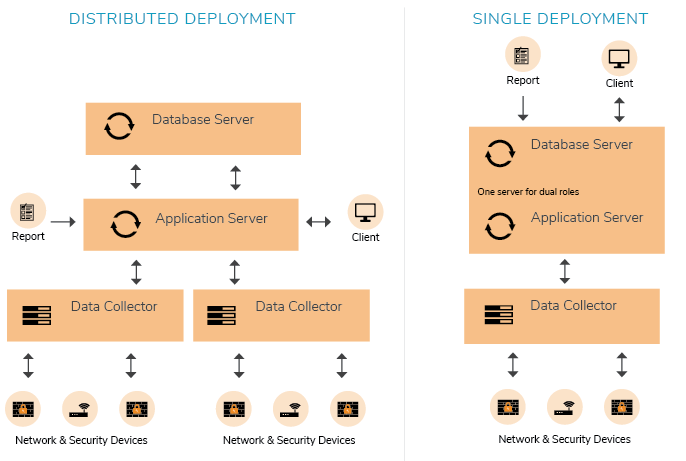
When first installing FMOS, the initial configuration wizard will check the local system to ensure it meets the minimum system requirements. These requirements provide an application server for all deployments. When planning the deployment, consider the following guidelines:
- Servers with the database (DB) role will require very large amounts of RAM, especially when generating reports or running assessments.
- Servers with the application server (AS) role will use a large amount of RAM and CPU time, and demand will increase as the number of users grows.
- Servers with the data collector (DC) role will use large amounts of RAM and CPU time, and demand will increase as the number of monitored devices grows.
When the install command is used to initiate installation, FMOS checks to determine if the hard drive is at least 480 GB. If it does not meet this requirement the installation is aborted. To install FMOS 9 on data collectors with hard drives less than 480 GB you will use the DC Only build variant.
Network Requirements
When deploying multiple servers, consider the following guidelines for best overall performance:
- All servers holding the application server role must be on the same network segment.
- If the application server and database roles are held by separate servers, those servers should be on the same network segment, with a very high bandwidth connection between them.
- Servers holding the data collector role should be located logically near the devices they monitor.
- Application servers must be able to resolve the database server by fully qualified domain name (FQDN) and be able to communicate with it using the following services (over IPv4 or IPv6):
- ICMP/ICMPv6
- IP protocol 50 (ESP)
- TCP ports 50 (NFS), 5432 (PostgreSQL), 55555 (FMOS Server Control Panel)
- UDP ports 500 (ISAKMP), 4500 (IPsec-NAT-T)
- Data collector servers must be able to resolve application servers by FQDN and be able to communicate with them over HTTPS (TCP port 443).
- A default gateway must be configured on all servers.
Additional ports to open are listed in the Communication Protocols topic.
Physical Machine Recommendations
These are the minimum system recommendations, based on FireMon's FM appliance system specifications. If you are using your own machine hardware, it is recommended that it has a system equivalent to an FM appliance.
| FM-720 Enterprise Server | FM-715 Data Collector | FM-1110 Enterprise Server | |
|---|---|---|---|
| Processor | 2x Intel Xeon Gold 6134 (3.2 GHz) | 2x Intel Xeon Gold 6128 (3.4 GHz) | 2x Intel Xeon Gold 6140 (2.3 GHz) |
| Memory | 12x 8 GB 2666 MT/s Dual Rank DDR4 RDIMM (96 GB) | 8x 8 GB 2666 MT/s Dual Rank DDR4 RDIMM (64 GB) | 8x 16 GB 2666 MT/s Dual Rank DDR4 RDIMM (128 GB) |
| Storage | 4x 600 GB 15K RPM 12 Gbit/s 2.5” SAS HDD | 2x 240 GB 6 Gbit/s 2.5” SATA SSD | 16x 300 GB 15K RPM 12 Gbit/s 2.5” SAS HDD |
|
Devices monitored* |
more than 50 400-standard, 1000-distributed |
350 | 15000 |
*These numbers are estimates only. The actual number of devices will vary based on the type of device, the size of configurations, and other environmental factors.
Small ecosystem deployments (50 maximum or fewer monitored devices) can use less memory as specified below.
Which machine is right for your organization?
Virtual Machine Recommendations
These are the minimum system recommendations to be used in a virtual machine environment.
| All-in-One Deployment (AS/DB/DC) | |
|---|---|
| Processor | 2.4 GHz or newer, 16 cores |
| Memory | 64 GB of RAM |
| Storage | 1.5 terabytes or greater (cannot be changed after installation) |
| NIC | 1 gigabit or greater |
| Devices monitored |
50 or less (no more than 50) |
| Standard Deployment (AS/DB + DC) 50 - devices | AS/DB | DC |
|---|---|---|
| Processor | 2.4 GHz or newer, 16 cores | 2.4 GHz or newer, 16 cores |
| Memory | 64 GB of RAM | 32 GB of RAM |
| Storage | 1.5 terabytes or greater (cannot be changed after installation) | 500 GB or greater (cannot be changed after installation) |
| NIC | 1 gigabit or greater | 1 gigabit or greater |
| Devices monitored |
50 or less (no more than 50) |
50 or less (no more than 50) |
| Standard Deployment (AS/DB + DC) 51+ devices | AS/DB | DC |
|---|---|---|
| Processor | 2.4 GHz or newer, 16 cores | 2.4 GHz or newer, 16 cores |
| Memory | 96 GB of RAM | 64 GB of RAM |
| Storage | 1.5 terabytes or greater (cannot be changed after installation) | 500 GB or greater (cannot be changed after installation) |
| NIC | 1 gigabit or greater | 1 gigabit or greater |
| Devices monitored |
51 devices or more |
51 devices or more |
| Fully Distributed Deployment (AS + DB + DC) | AS | DB | DC |
|---|---|---|---|
| Processor | 2.4 GHz or newer, 16 cores | 2.4 GHz or newer, 16 cores | 2.4 GHz or newer, 16 cores |
| Memory | 96 GB of RAM | 128 GB of RAM | 64 GB of RAM |
| Storage | 500 GB or greater (cannot be changed after installation) | 1.5 terabytes or greater (cannot be changed after installation) | 500 GB or greater (cannot be changed after installation) |
| NIC | 1 gigabit or greater | 1 gigabit or greater | 1 gigabit or greater |
| Devices monitored |
51 devices or more |
51 devices or more |
51 devices or more |